
Diesel owners love big upgrades: turbos, injectors, and tuning. All the fun stuff. But the parts that quietly deal with the most violence inside the engine aren’t glamorous. They don’t whistle, and nobody brags about them at the fuel pump.
They’re the fasteners that hold your engine together.
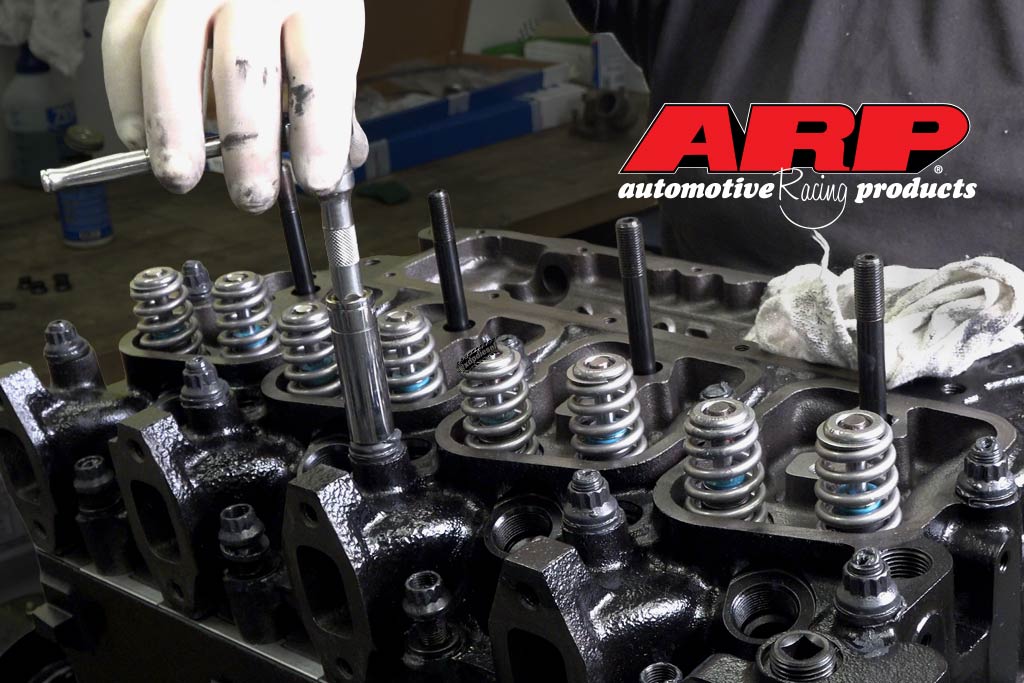
Every diesel owner has seen it: the build that gets more fuel, more air, and a more aggressive tune as power goals climb. Most builders know hardware matters, but when cylinder pressures start pushing higher, even well-planned builds begin to test the limits of what stock fasteners were designed to handle. In a high-boost, high-stress diesel, peak cylinder pressures rise dramatically under full load, placing enormous force on the components and fasteners holding the engine together. 7
That pressure is invisible; you don’t hear it, smell it, or see it, but you’ll absolutely pay for it when the hardware holding the engine together isn’t up to the job.
That’s the critical part that can’t be overlooked. Before a head gasket ever fails, or a rod lets go, the hardware is fighting to keep everything where it belongs.
Head studs. Rod bolts. Main studs. These little pieces of alloy steel sit deep in the engine where nobody ever sees them, managing cylinder pressure, heat cycles, harmonics, and the shock loads that happen every time you roll into the throttle. No bolt or stud can promise invincibility, but using high-quality hardware can definitely help an engine tolerate stress more consistently.
ARP Fasteners
That brings us to ARP: one of the few companies that treats fasteners like critical performance components instead of just “hardware.”
And today, we’re taking a closer look at three of their most popular ARP fasteners with unboxing videos, plus a peek behind the scenes at what makes ARP so respected in the first place.
ARP in 60 Seconds: Born From Broken Parts
People say success starts with spotting a need and stepping in to solve it. That’s exactly what happened in 1968. Racing enthusiast Gary Holzapfel kept seeing the same issue pop up in his friends’ engines: fasteners that couldn’t handle high-performance stress were causing unnecessary failures. The aftermarket industry just didn’t offer hardware strong enough for the power being added to engines at the time.
Holzapfel had already spent years manufacturing precision fasteners for a major aerospace subcontractor, so he understood what it would take to build hardware that could survive real abuse. He took that knowledge and started what became Automotive Racing Products, better known as ARP, out of a small garage workshop in Southern California. What began as a backyard operation has since grown into a multi-facility manufacturer whose fasteners are trusted anywhere durability matters.
Today, ARP hardware shows up everywhere, from competition diesel trucks and high-boost street builds to heavy-haulers, small-block and big-block performance engines, and some of the world’s most demanding racing environments like Formula 1, IndyCar, NASCAR, and NHRA drag racing.
Why? That’s easy: consistency. ARP doesn’t just make strong fasteners; they make predictable ones.
Why Fasteners Matter More Than Most People Think
Fasteners don’t create horsepower. They don’t make boost. But they do something just as important: they hold everything together.1
And in a diesel engine, especially one running increased boost or elevated RPMs, clamping force is constantly fighting against extreme, fluctuating loads deep inside the engine. Those forces change rapidly with combustion, heat, and engine speed, placing repeated stress on the hardware that keeps critical components clamped in place.
OEM hardware is designed around stock performance levels and normal driving conditions. Once cylinder pressure goes up or the engine sees heavier-than-stock use, fasteners become a potential weak point.
No upgrade is a fail-proof guarantee, but upgrading to high-quality, tested, consistent hardware helps reduce the risk of unpredictable movement or stretch under those added stresses.2
And that’s where ARP’s engineering mindset really matters.
Inside ARP’s Engineering Philosophy
You don’t need a degree in metallurgy to understand what makes ARP interesting. Here’s the short version:
1. The Alloys Are Different
- ARP uses materials like 8740 steel and ARP2000, alloys selected for strength, fatigue resistance, and heat tolerance. 3 4
- ARP2000 is heat-treatable to significantly higher strength levels than 8740. 4
- 8740 steel achieves optimal fatigue strength and durability when combined with post–heat-treat thread rolling, which helps maintain proper grain flow at the thread roots. 5
2. The Manufacturing Is Controlled In-House
- ARP controls heat-treating, shot-peening, grinding, and thread rolling. 5
- Threads are rolled after heat-treating on all high-strength fasteners, which ARP emphasizes as essential to grain structure integrity. 5
3. The Goal Isn’t Just Strength; It’s Repeatability
- ARP highlights manufacturing consistency, process control, and predictable fastener behavior, from alloy selection to final machining. 5
- A bolt that behaves consistently under torque helps ensure predictable clamping force. 1
This level of control isn’t marketing fluff. These are the kind of details racers and engine builders obsess over because just one bolt stretching when it shouldn’t can derail an entire build.
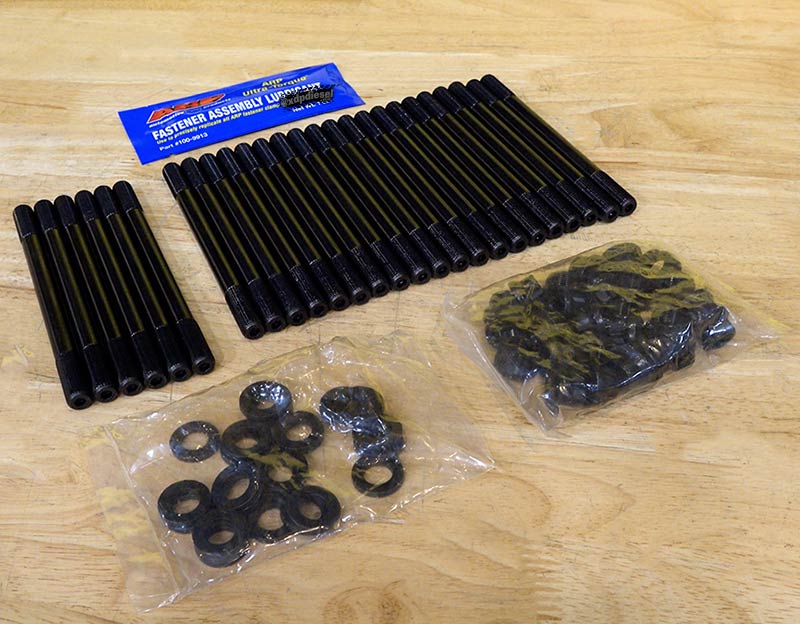
ARP Head Stud Kit
When Cylinder Pressure Wants to Lift the Head
Diesel engines create extremely high cylinder pressures, and that pressure puts a tremendous amount of load on the fasteners that hold the cylinder head to the block. Keeping that clamping force consistent is a major part of maintaining sealing under heavy use. 6
Why Builders Choose These Studs
ARP explains that their head studs are made from premium alloys like 8740 and ARP2000, materials designed for high clamp loads and excellent fatigue strength. 3 4
These studs are manufactured using ARP’s controlled processes, including heat-treating and rolling the threads after heat-treat to help maintain strength and consistency under high stress. 5
Engine builders often choose these studs because they offer:
- Consistent clamping force thanks to high-strength alloys 3 4
- Improved fatigue resistance under repeated load cycles 3
- Manufacturing consistency from ARP’s in-house process control 5
- High clamp load capability for demanding applications 4
Installing high-quality studs like these helps reduce variables during assembly and gives builders confidence when engines are subjected to elevated boost or heavy workloads.2
Upgraded head studs aren’t limited to high-horsepower builds. Some engines can experience sealing challenges even at or near stock power levels, where maintaining consistent clamping force is critical. Platforms like the 6.0L Power Stroke are a well-known example, where head studs are commonly used not just for added power, but to improve clamping consistency and help support long-term reliability.
ARP Rod Bolt Kit
The Bottom End Is Violent
The critical stress inside a diesel engine isn’t always easy to visualize. One way to put it into perspective is to look at what the rotating assembly is doing in real time.
Mechanical calculation: At 2,800 RPM, a connecting rod changes direction 93 times per second. At 3,500 RPM, 116 times per second.7
Why Upgraded Rod Bolts Help
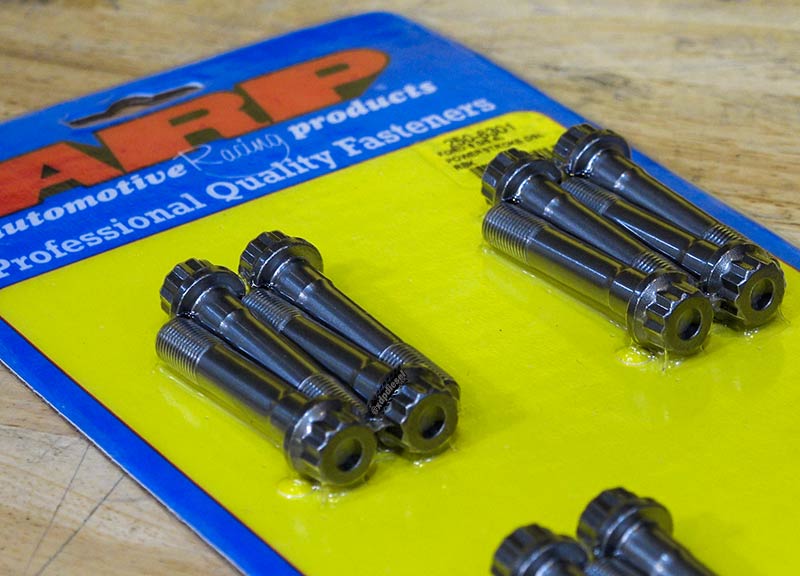
Rod bolts hold the connecting rod cap to the connecting rod and help keep the big end of the connecting rod round when the engine is under serious load. OEM connecting rod bolts can stretch and lose clamping force, while stronger connecting rod bolts help the rod stay in shape and the bearings remain stable.
- Higher tensile strength 4
- Better fatigue resistance 3
- More consistent clamping under repeated high-load cycles5
ARP Ultra-Torque Fastener Assembly Lubricant
Torque Is Not What Most People Think
When you set your torque wrench to 150 ft-lb, only a portion becomes clamping force; the rest is lost to friction. 1
Why Specialized Lubricant Matters
ARP Ultra-Torque is engineered to produce more consistent friction coefficients, leading to:
- More accurate torque readings 8
- More predictable stretch 8
- Even clamping across the fastener set 8
Putting It All Together: The Fastener Ecosystem
These products don’t work alone:
- ARP Head Studs help resist upward cylinder pressure
- ARP Rod Bolts help maintain rotating-assembly geometry
- Ultra-Torque Assembly Lubricant helps everything clamp predictably
Together, they help support reliability in engines that are tuned, worked, and expected to perform beyond factory limits.
No fastener can promise disaster prevention, but reducing variables can help support long-term engine consistency. 5
The Unsung Hardware Behind a Reliable Diesel Engine
Fasteners aren’t shiny. They don’t whistle, spool, or light up your dash. But they’re down in the dark, taking every punch your diesel throws; the heat, the pressure spikes, the vibration, the constant beating that comes with towing heavy or leaning into the throttle a little harder than you should. They don’t get much glory, but they carry more load than most people realize.
And that brings us back to where we started. Power adders are exciting. Tuning is addictive. But sooner or later, every diesel owner learns the same lesson: power doesn’t matter if the hardware underneath can’t hold the line. Reliability comes from the parts no one brags about, the stuff buried so deep in the engine you only see it when something goes wrong.
That’s why ARP has the reputation it does. Their obsession with alloys, heat-treating, thread rolling, and consistency isn’t just manufacturing, it’s the kind of craftsmanship that lets builders push their engines without second-guessing what’s happening inside.
Whether you’re running more boost, working your truck day in and day out, or just want your truck to feel solid every time you turn the key, ARP fasteners help provide the stability that keeps everything else working.

Sources:
1. Understanding Fastener Torque & Clamping Force | ARP
https://arp-bolts.com/p/faq.php
2. General Product Philosophy (Consistency & Testing) | ARP
https://arp-bolts.com/
3. Technical Information: 8740 Alloy | ARP
https://arp-bolts.com/p/technical.php (scroll to 8740 section)
4. Technical Information: ARP2000 Alloy | ARP
https://arp-bolts.com/p/technical.php (scroll to ARP2000 section)
5. Manufacturing Process Overview | ARP
https://arp-bolts.com/p/manufacturing.php
6. Company Origins & Manufacturing Background | ARP
https://arp-bolts.com/p/about.php
7. Ultra-Torque Fastener Assembly Lubricant Technical Data
https://arp-bolts.com/p/arpultratorque.php
8. Heywood, J.B. – Internal Combustion Engine Fundamentals
(Standard reference for engine kinematics, including connecting-rod reversal at TDC/BDC)