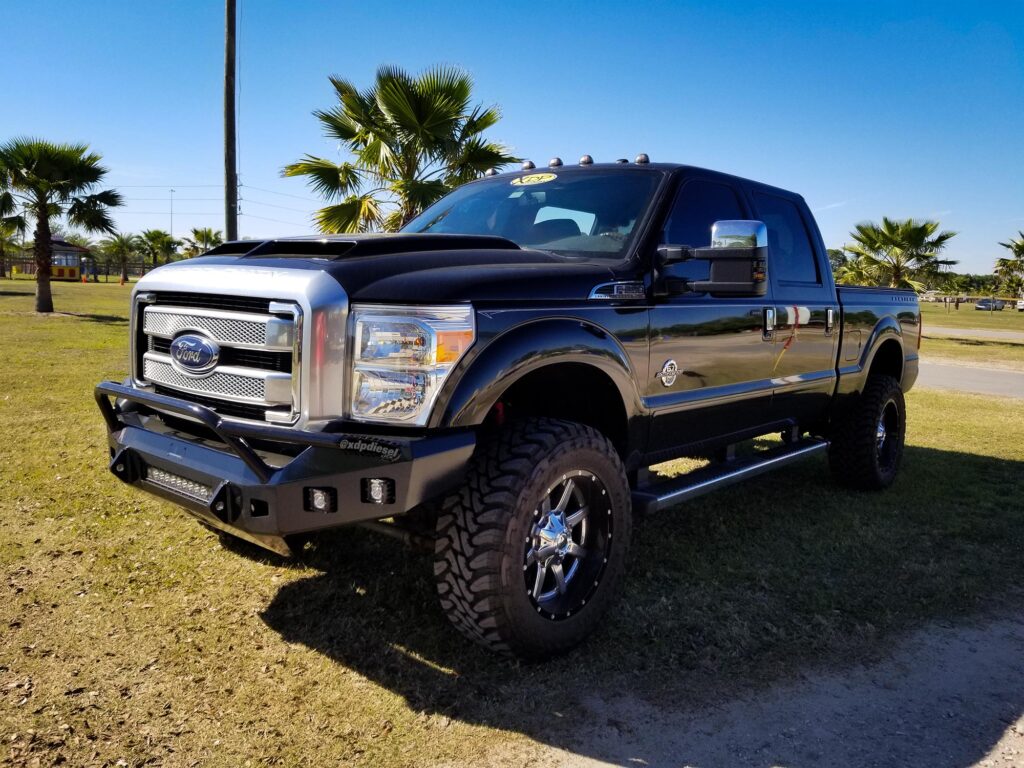
If you’re shopping for a used 2011-2016 Ford Super Duty, the 6.7L Power Stroke is one of the biggest reasons these trucks remain so popular. Introduced for the 2011 model year, the code-named “Scorpion” 6.7L Power Stroke was Ford’s first in-house diesel engine and a major shift away from the Navistar-supplied engines used in previous generations. Like any used diesel truck, the 6.7L Power Stroke has a few known trouble spots, which we’ll cover later in this guide.1,2 This generation was also the last Super Duty to feature traditional steel body construction before Ford transitioned to an aluminum-bodied design for 2017.
Scorpion Engine
The all-new 6.7L Power Stroke featured a new 90-degree V8 engine design with a compacted graphite iron (CGI) engine block and aluminum cylinder heads. One of the engine’s most innovative features was its reversed intake and exhaust manifold layout. The intake ports were located on the outside of the cylinder heads, while the exhaust ports exited into the engine valley, where a centrally mounted turbocharger was positioned. Because of this unique design, the 6.7L was internally code-named “Scorpion” during development.3
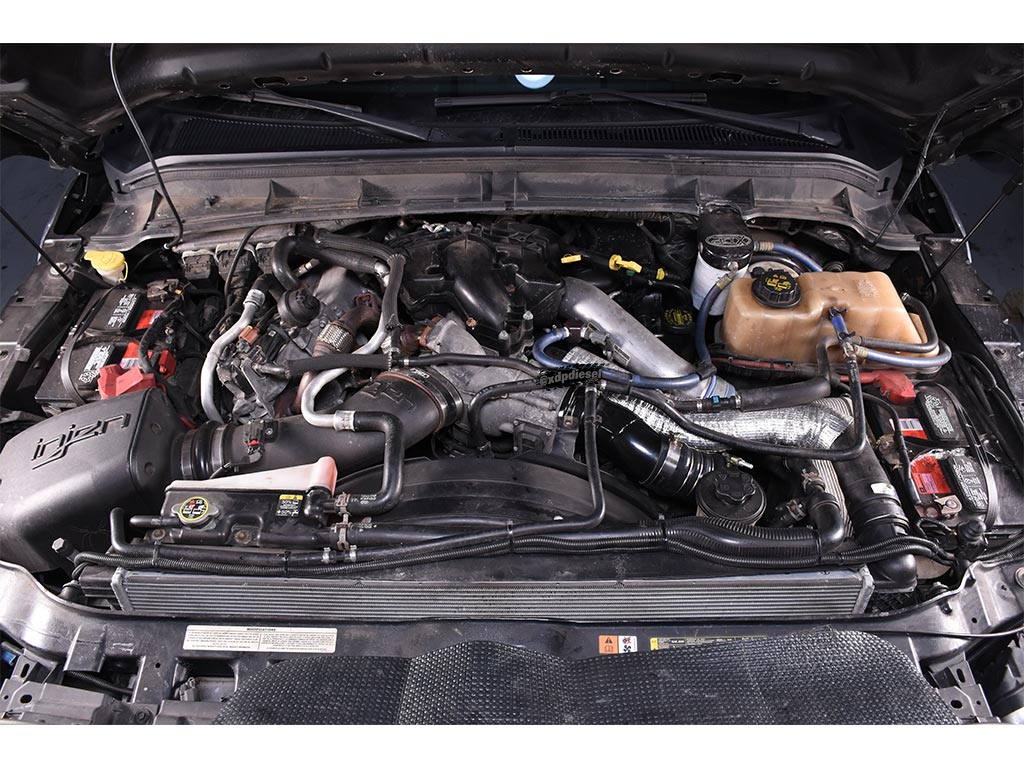
6.7 Powerstroke Bottom End
The 6.7L engine block was built from compacted graphite iron (CGI), which helped reduce weight while improving strength and Noise, Vibration, and Harshness (NVH). The forged modular steel crankshaft used a one-piece rear flange for improved sealing and increased torque capacity, along with a fillet radius on each journal, fully lightened crankshaft pins, and two radiused counterweights.
The 6.7L Power Stroke also came equipped with aluminum pistons (2011-2019) and fractured-cap connecting rods. The camshaft and high-pressure fuel pump were driven off the crankshaft, and the timing gears were accessible by removing the front cover. The camshaft used one exhaust lobe and one intake lobe per cylinder.
6.7 Powerstroke Top End
The 6.7L Power Stroke used an innovative cylinder head design with reversed intake and exhaust port locations. The intake ports were positioned on the outside of the heads, while the exhaust ports faced the engine valley. This design created a more efficient layout and helped reduce overall engine weight. The aluminum heads also used six bolts per cylinder to help secure the heads to the block.
Each cylinder features two exhaust valves and two intake valves. Each valve has its own rocker arm and pushrod, while the rocker arms for each cylinder ride on a common fulcrum. The roller lifters contain two hydraulic lash adjusters, and each valve is individually actuated through its own pushrod and rocker arm. This eliminated the floating bridge used to open a pair of valves with a single rocker arm, improving wear performance and NVH. Both cylinder heads also include a rocker arm oiling manifold that cools and lubricates the valves and rocker arms.4
6R140 Transmission
For the 2011 model year, Ford introduced the 6R140W transmission, also known as the TorqShift 6. Unlike the 5R110W it replaced, the 6R140W was a true six-speed automatic. The 5R110W transmission used in 2003-2010 Ford 6.0L and 6.4L Power Stroke trucks had six available ratios but only used five forward gears, depending on ambient temperature.10
6R140W Transmisison Gear Ratios 11
| 1st Gear | 2nd Gear | 3rd Gear | 4th Gear | 5th Gear | 6th Gear | Reverse |
| 3.974 | 2.318 | 1.516 | 1.149 | 0.858 | 0.674 | 3.128 |
Fuel System
The 6.7L Power Stroke used an all-new high-pressure common-rail fuel injection system. At the heart of the system was a Bosch CP4.2 fuel injection pump, which produced up to 30,000 psi of fuel pressure. Fuel traveled through two fuel rails and individual lines to each injector. Bosch 19 mm piezo-actuated injectors with eight-hole nozzles delivered fuel to each cylinder and could be serviced without removing the valve covers. Each injector was retained with a single clamp and bolt through the rocker cover into the cylinder head. An electric lift pump was incorporated into the Diesel Fuel Conditioning Module (DFCM), supplying fuel to the CP4 and returning unused fuel to the tank.4
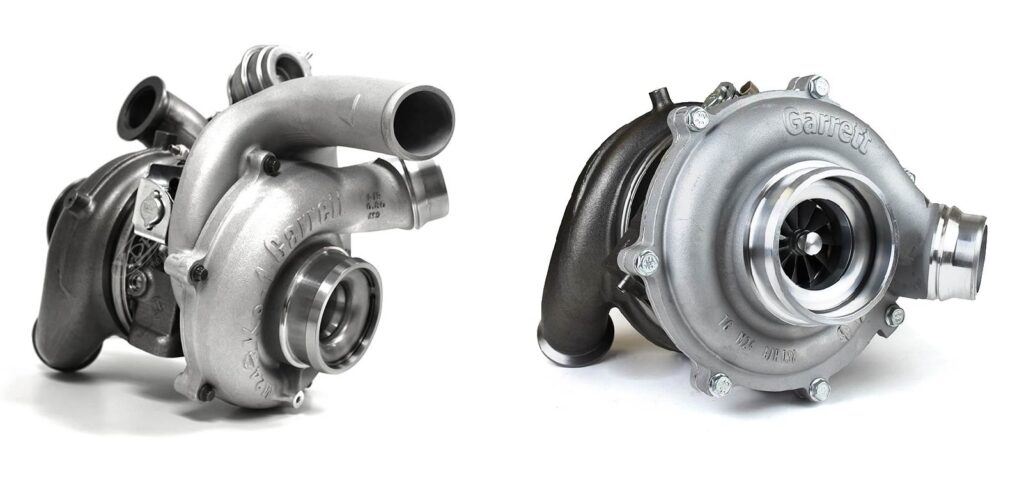
2011-2014 Garrett SST3266V (left) vs 2015-2016 Garrett AVNT3788 (right)
Turbocharger System
Pickup Models
First-generation 6.7L Super Duty pickup trucks (2011-2014) came equipped with a Garrett SST3266V single-sequential “DualBoost” turbocharger. The DualBoost VGT turbo featured two intake compressors and one exhaust turbine on a common shaft, allowing it to act similarly to a two-stage system without the packaging complexity or added weight of a second turbocharger.5
In 2015, Ford switched pickup trucks to a Garrett AVNT3788 Variable Geometry Turbocharger (VGT). This single-compressor turbo was larger than the DualBoost turbo it replaced and used variable vanes to control turbocharger speed with exhaust gas flow. The turbocharger was capable of producing up to 30 psi of boost (206.84 kPa) at up to 130,000 RPM.
Cab & Chassis
Cab & Chassis models used different turbochargers than pickup models. From 2011-2016, Cab & Chassis models used a Garrett AVNT3276V, while F-650/F-750 models used a Garrett GT3582V. All 6.7L turbochargers were integrated into the primary cooling system and were water-cooled.
Intercooler
Another major feature of the 6.7L Power Stroke was its air-to-water charge air cooler, or intercooler. This setup used engine coolant as part of the secondary cooling system to remove heat from the intake air charge. It was a major change from previous Power Stroke engines, which used a more traditional air-to-air intercooler system. Because water transfers heat more effectively than air, this design helped lower intake air temperatures while providing strong cooling capacity in a smaller underhood package.
Cooling System
The 6.7L Power Stroke used two separate cooling systems. Each system had its own radiator, degas bottle, thermostats, and belt-driven water pump. The primary cooling system is often referred to as the high-temperature system, while the powertrain secondary cooling system is often called the low-temperature system. The secondary radiator was mounted in front of the primary radiator, allowing it to operate at a lower temperature than the primary system.4
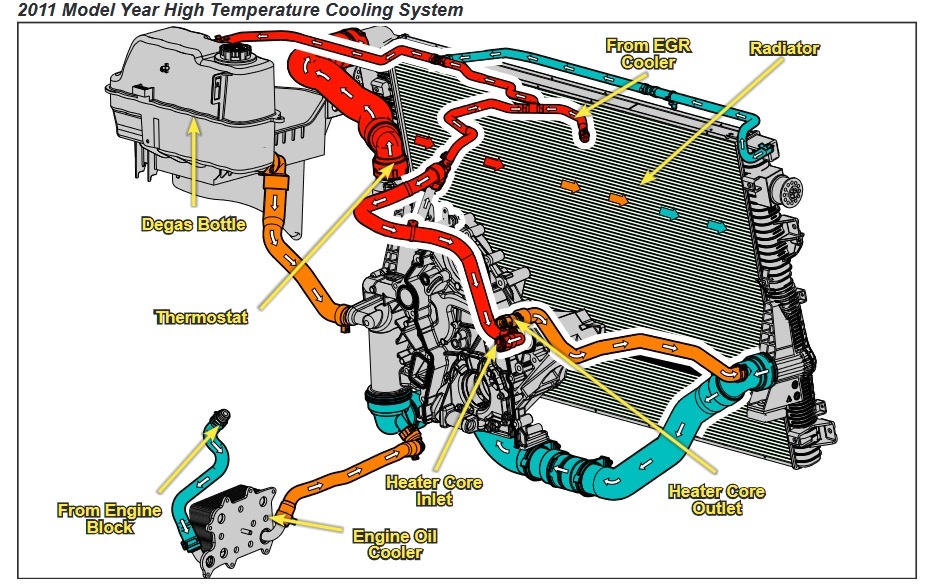
6.7 Primary Cooling System
- Engine Block
- Cylinder Heads
- Engine Oil Cooler
- Turbocharger
- Heater Core
- EGR Cooler (From Oil Cooler)
Dual Thermostats
A dual thermostat system controls the flow of return coolant to the radiator. When the thermostats are open, coolant flows to the radiator to be cooled. If they are closed the coolant circulates through a bypass passage in the left cylinder head/engine block. It then gets returned to the pump inlet. The primary thermostat assembly features two thermostatic devices. This unit is located in the coolant crossover at the front of the engine. The thermostats regulate the engine coolant temperature by controlling the flow of coolant through the primary radiator. The two thermostats are staggered by design, so they do not open at the same temperature. The first thermostat opens at 194°F, with the second opening at 201°F.4
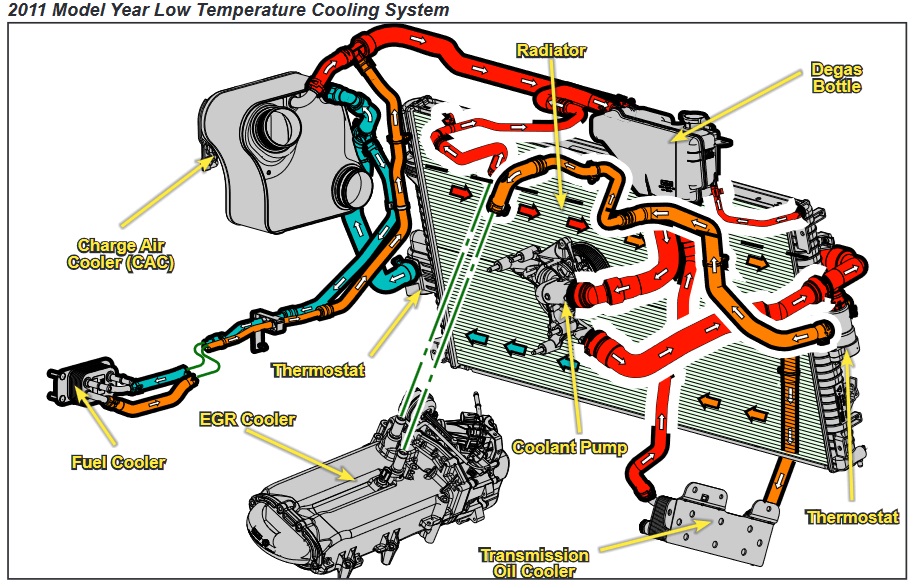
6.7 Powertrain Secondary Cooling System
- Charge-Air-Cooler (CAC)
- Fuel Cooler
- Transmission Cooler
- EGR Cooler (From Right Side Of Radiator)
The secondary cooling system (low temperature) radiator features two outlets. One located on each side of the radiator, each controlled by a thermostat. The passenger side outlet is controlled by a 140° F thermostat. This provides coolant to the EGR cooler and trans oil cooler. The driver side outlet is controlled by a 113° F thermostat and provides coolant to the CAC and fuel cooler.4
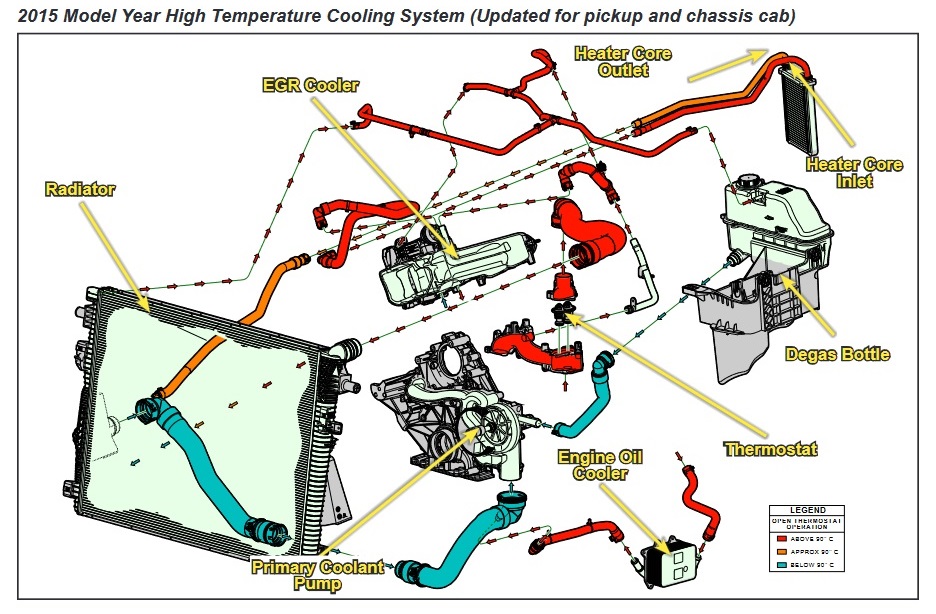
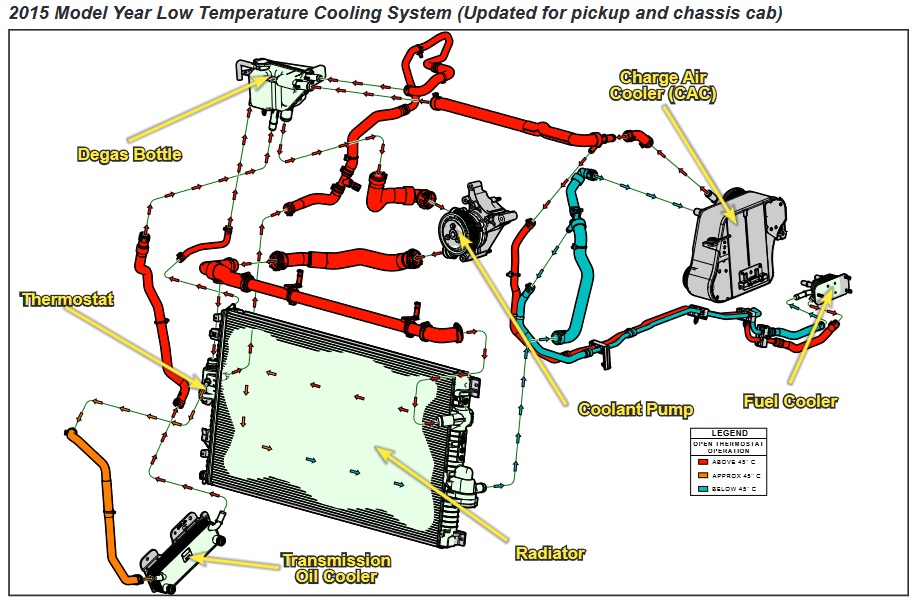
2015 Ford 6.7 Cooling System Updates
For the 2015 model year, Ford made some slight changes to the cooling system. The EGR was now cooled by the primary cooling system exclusively. In previous years, the EGR Cooler had used a combination of both the primary and secondary system for cooling. This helped to reduce heat loads on the secondary cooling system.6
Emissions System
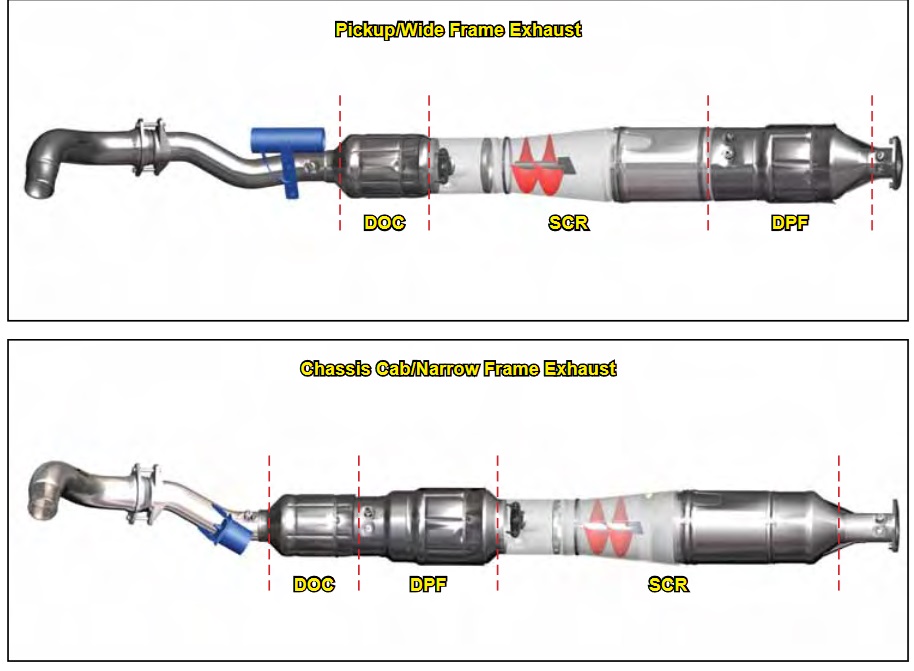
The 6.7 Powerstroke featured a sophisticated emissions control system including advanced exhaust after treatment solutions such as a Diesel Oxidation Catalyst (DOC), Selective Catalyst Reduction (SCR), and a Diesel Particulate Filter (DPF).6
Exhaust Gas Recirculation (EGR)
Exhaust gas recirculation is the first step in reducing emissions of nitrous oxides (NOx). By cooling and reintroducing a metered amount of exhaust gases into the intake air charge, combustion temperatures are reduced, and NOx emissions are decreased substantially. The EGR cooler is mounted above the passenger side valve cover and features a two-stage cooling circuit. While early engines (2011 – 2014) relied on the primary cooling system for the first stage of cooling and the secondary cooling system for the second stage, all 2015 and newer model year engines cool both stages with the primary cooling system. A throttle body mounted to the mouth of the lower intake manifold is employed to promote EGR exhaust flow by creating a differential pressure between the intake and EGR systems.6
Selective Catalytic Reduction (SCR)
To reduce NOx in the exhaust, a Selective Catalytic Reduction (SCR) system was incorporated. The SCR converts nitrogen oxides (NOx) present in the exhaust into nitrogen gas (N2) and water (H2O). The SCR contains a ceramic catalyst, coated with copper and iron on a zeolite substrate. A reductant dosing module is mounted at the inlet of the SCR and sprays Diesel Exhaust Fluid (DEF) into the exhaust stream.
Diesel Particulate Filter (DPF)
The Diesel Particulate Filter (DPF) is designed to trap particulates using a silicon carbide catalyst and reduce black smoke from the tailpipe. On pickup models, it is mounted behind the SCR unit. On Cab & Chassis trucks, it is mounted in front of the SCR system. As soot accumulates in the aftertreatment system, exhaust flow can become restricted. A regeneration process burns off soot inside the DPF.
2011 Power Increase
The 6.7L Power Stroke diesel was originally launched at ratings of 390 horsepower and 735 lb-ft of torque. On August 3rd, 2010, Ford Motor Company announced that horsepower and torque ratings for the 6.7L Power Stroke diesel had been raised to 400 horsepower and 800 lb-ft of torque.6 Owners of the 390 horsepower model engines were able to receive a free PCM calibration upgrade to the new power figures. These actions were Ford’s response to General Motor’s announcement of performance figures for the next generation 6.6L Duramax LML, (397 hp, 765 lb-ft of torque); the Powerstroke’s performance bump helped maintain Ford’s position as the segment leader in power and torque ratings.
2011-2014 Updates – 6.7 Powerstroke
The 6.7 Powerstroke was released in 2010 for the 2011 model year. Ford made some minor updates to the engine after its initial release.6 The following were changes that were implemented between 2011 and 2014.
- Increased Horsepower & Torque #’s (PCM Update Released Shortly After The Initial 6.7 Release)
- Stamped Steel Lower Oil Pan With Conventional Drain Plug (2012 Update)
- Replaced Composite Oil Pan with Quarter Turn Drain Plug
- Oil Cooler Updated To Remove Hidden Mounting Point/Stud (2012 Update)
- When Servicing The Oil Cooler The Lower Oil Pan No Longer Required Removal
- Crankcase Ventilation Sensor Added (2013 Update)
- Diesel Particualte Filter (DPF) Delta Pressure Sensor Added (2013 Update)
- Second NOx Sensor & Module Added (2013 Update)
2015 Model Year Updates – 6.7 Powerstroke
For 2015, Ford incorporated some additional changes/updates to the 6.7L Powerstroke.6 The 2015-2019 model years would go on to become known as 2nd Gen (or Gen II) 6.7 engine.
- IROX® Polymer Coating On The Lower Main Bearings (Pickup & Cab & Chassis)
- Revised Heavier Crankshaft Damper (Pickup & Cab & Chassis)
- Updated Fan Clutch
- Exhaust Gas Recirculation (EGR) Inlet Temp sensor (Pickup Only)
- New Turbocharger (Pickup Only)
- New Lower Intake
- Electronic Vacuum Regulator Valve & Actuator Deleted
- Wastegate Deleted
- Updated Oil & Coolant Feed Lines To Turbo (Changed From Quick Connections To Bolt Fasteners)
- EGR Cooler Cooled By Primary Cooling System Only (Pickup & Cab & Chassis)
- Fuel Pressure & Temperature Sensor (Low Pressure Fuel System) Combined
- New Sensor Featured Both A Temperature Probe & Fuel Pressure Port
- New High-Pressure Fuel Pump & Fuel Injectors (Pickup Only)
- Components Look The Same
- Longer Stroke In The Fuel Pump
- All New Fuel Injector Tip
- New Up-Pipes & Downpipe (Pickup Only)
- Particulate Matter Sensor & Module Added After The Diesel Particulate Filter (DPF)
6.7 Powerstroke Common Problems
While all 6.7L Power Stroke model years can experience issues, 2011-2014 trucks have typically seen a larger share of problems. That is common with the first generation of many vehicles, and Ford continued making revisions over time to address several early concerns. Most enthusiasts agree that the 6.7L Power Stroke became more reliable as it evolved, making second- and third-generation trucks more desirable for many buyers.
The following are some of the common problems that have been associated with the Ford 6.7, in no particular order.
- Check service records: Regular oil changes, fuel-filter changes, coolant service, and transmission maintenance are all important on these trucks.
- Scan for codes: Look for stored or pending codes related to the fuel system, turbocharger, EGR system, DPF, DEF system, and NOx sensors.
- Inspect for rust: Pay close attention to rocker panels, cab corners, bed supports, frame areas, and trucks from northern climates.
- Watch for modifications: Tuners, oversized tires, lift kits, and heavy towing use can all affect reliability and resale value.
CP4.2 Fuel Injection Pump
The CP4 injection pump is one of the biggest items to understand before buying a 6.7L Power Stroke. If the CP4 fails, it can send metal debris throughout the fuel system. When that happens, the fuel injectors, fuel rails, fuel lines, CP4 pump, and related components may need to be replaced. Before buying, ask whether the truck has had fuel-system repairs, confirm that fuel filters were serviced regularly, and consider whether a disaster-prevention kit or DCR conversion has already been installed. Read more about the CP4 pump here – What is a CP4 Pump and Why Does It Fail?
Turbocharger (2011-2014 Model Years)
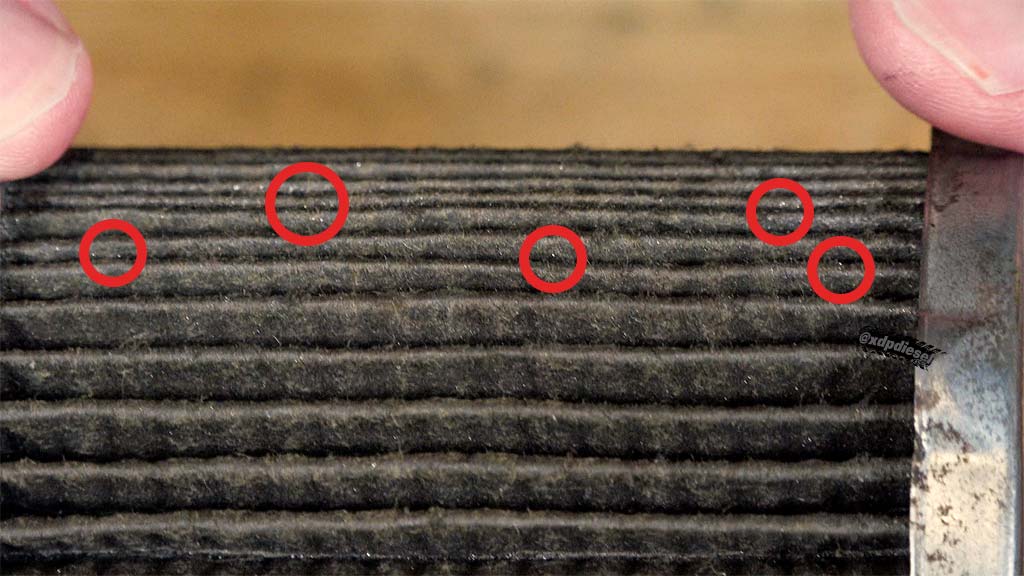
While the ceramic ball bearings used in 2011-2012 turbos are a well-known failure point, turbocharger issues were not limited to those model years. Some 2013-2014 trucks also experienced failures related to the dual-sided compressor wheel design. Ford introduced a revised turbocharger for 2015 that improved durability and reliability compared to the earlier units.
Exhaust Valve Seats
Some 2011 Super Duty’s built on or before 3/29/2011 experienced a dropped valve guide and broken glow plug, resulting in catastrophic engine damage. Ford released a Technical Service Bulletin 12-11-11/14-01278 with symptoms including an engine that runs rough or no crank, as well as DTCs P0671, P0672, P0673, P0674, P0675, P0676, P0677, and/or P0678. Ford redesigned the cylinder heads and glow plugs to fix the issue.
EGR Cooler Issues (soot build-up)
The EGR Cooler doesn’t fail like they did on the 6.0 and 6.4 models, but they can be prone to severe soot buildup. Ford sent out a Customer Satisfaction Program 21M04 letter detailing the issue, but the no-cost repair coverage expired on January 31, 2023. This issue often results in a P0401 and/or P2457 DTC. If this occurs, replacement of the cooler is required.
NOx Sensor Failure
The NOx sensors can be failure prone on the 6.7. Ford issued a Customer Satisfaction Program 12B33 for 2011-2012 Super Duty models, as well as a recall 21E01/21N029 to address the NOx sensors on 2013-2016 model years.
Cracked Exhaust Manifolds
The exhaust manifolds in the 6.7 can crack leading to an exhaust leak, reduced performance, a ticking noise, as well as a Check Engine Light (CEL) on the dash.
Upper Oil Pan Leaks (Early Model Years)
Early 6.7L Power Stroke engines are also known for developing upper oil pan leaks. Repairing the leak can be labor-intensive, as access to the upper oil pan typically requires significant engine disassembly.
Radiator & Coolant System Leaks
These leaks were primarily found on early trucks, while Ford was able to resolve this issue over the years.
Crankcase Ventilation (CCV) System
The 6.7L Power Stroke utilizes a crankcase ventilation (CCV) oil separator to help remove oil vapor before it is routed back into the intake system. Over time, oil accumulation and normal wear can affect system performance, making periodic inspection and maintenance important for long-term reliability.
Pros/Cons
Pros
- 6R140 Transmission
- State Of The Art Technology
- Increased Horsepower & Torque
- Compacted Graphite Iron (CGI) Engine Block
- Aluminum Cylinder Head Design
- Ford’s First In-house Diesel Engine Design
Cons
- Fuel Economy
- Potential CP4 Fuel Pump Failures
- Complex Design Can Make It Harder To Work On
- NOx Sensor Failures
- High Repair Costs for Fuel System Failures
6.7 Powerstroke Review
The Ford 6.7 Powerstroke was a big step forward for Ford. Since Ford started with a clean sheet, they were able to introduce a lot of new technology, increase horsepower and torque, and fix many of the shortcomings found on previous Powerstroke diesel engines. Ford fixed or updated many issues as they were discovered so it can be beneficial to try and buy a later model. For earlier models, a service history or receipts of the work performed can help you budget for possible future repairs.
As with any vehicle, rust can be an issue particularly in trucks that spent time in the rust belt (cold climates). Areas like the rocker panels, cab corners, and bed are all susceptible to rust/rot. Many of these trucks were also used to plow snow which can accelerate the rusting process as they are exposed to moisture from snow and ice for extended periods of time, combined with the corrosive effects of road salt used to melt snow.
6.7L Powerstroke Popular Aftermarket Upgrades
1. CP4 Disaster Prevention Bypass Kit
Help protect your 6.7 Powerstroke from a CP4 failure with a CP4 Disaster Prevention Bypass Kit. This kit is designed to safeguard your fuel injectors, rails, and lines, from CP4 debris.
Protect your fuel system: CP4 Disaster Prevention Bypass Kit
2. CP4 To DCR Fuel Pump Conversion
The factory CP4 high-pressure fuel pump has been a point of concern for many 6.7L Power Stroke owners, leading to the popularity of products such as the S&S Diesel Motorsport DCR Fuel Pump Conversion Kit. If the CP4 fails, it can contaminate the fuel system with metal debris, and repairs can easily exceed $10,000.
Upgrade your fuel system: DCR Fuel Pump Conversion Kit
3. Tuner/Hand-Held Programmer
A tuner or handheld programmer can add power and torque to your 6.7L Power Stroke. Some tuners and monitors can also function as a complete gauge package, allowing you to monitor vital engine and transmission data in real time.
Search a wide selection of choices: Tuner/Programmer
4. Air Intake System/Cold Air Kit
Installing an air intake system, often called a cold air kit, can increase the amount of cool, dense air entering the engine. This can help improve performance and efficiency, which is why cold air kits are a popular upgrade for many diesel trucks.
Find one for your truck: Cold Air Kit
5. Exhaust
Reduce backpressure, lower EGTs, and get the most from your cold-air intake and programmer/tuner with an aftermarket exhaust.
Search the wide selection of choices: Exhaust
6. HD Intercooler Pipe With Billet Adapter
From the factory the trucks were equipped with a plastic intercooler pipe which has been known to crack and fail. The XDP HD Intercooler Pipe XD305 upgraded pipe for the cold-side features a mandrel-bent, bead-rolled 3″ steel pipe and reinforced silicone couplers for extreme durability. It also includes a specially machined billet adapter that snaps into the OEM location and does not require any modifications or aftermarket tuning for installation.
Replace your failure-prone pipe: HD Intercooler Pipe
7. Coolant Filtration System
Due to the cast engine design, traces of casting sand and sediment could be left over after the engine was manufactured. These contaminants are known to damage components in the cooling system. A Coolant Filtration System helps extend the life of your coolant, oil cooler, turbocharger, EGR coolers, and other vital components.
Protect your cooling system: Coolant Filtration System
8. Radiator
The radiators can begin to develop leaks, especially on earlier models. One common issue is the ends of the radiator where the crimps holding the plastic end tanks will loosen up over time.
Restore your cooling system: Radiators
9. Body Mounts
Worn body mounts can begin to cause body alignment issues, and many other problems such as body roll, door rattling, shifting issues, and even more problems with components that attach to the body and chassis like the radiator.
Replace the worn body mounts on your Super Duty: Body Mounts
10. Oil Cooler
A common failure item on the 6.7 the oil cooler is prone to clogging from debris in the cooling system. Similar to earlier Powerstrokes, the oil cooler can require eventual replacement.
Search a wide selection of choices: Oil Coolers
11. EGR Cooler
Another failure-prone item is the EGR Cooler. Over time they can crack and allow coolant to mix with the exhaust.
Shop for EGR coolers: EGR Coolers

2011-2016 Ford 6.7L Powerstroke Specifications
| Production Years: | 2011, 2012, 2013, 2014, 2015, 2016 |
| Model Availability: | F250, F350, F350, F450, F550, F650, F760 |
| Common Names: | 6.7, 6.7L, Powerstroke |
| Configuration: | V8 |
| Displacement: | 406 cubic inches, 6.65 liters |
| Bore: | 3.897″ (99 mm) |
| Stroke: | 4.251″ (108mm) |
| Cylinder Head: | Aluminum Alloy |
| Engine Block: | Compacted Graphite Iron (CGI) |
| Firing Order: | 1-3-7-2-6-5-4-8 |
| Compression Ratio: | 16.2 : 1 |
| Pistons: | Cast Aluminum. Oil cooled – Internal Passage Integrated Into The Bottom Of Each Piston Allows Oil To Flow Through And Cool The Top Of The Piston |
| Connecting Rods: | Fractured Cap Connecting Rods |
| Crankshaft: | Steel Crankshaft With Shrink Fit Camshaft Drive Gear |
| Fuel Injection: | Direct Injection, High-Pressure Common Rail 30,000 PSI Max Injection Pressure 19 mm Piezo Electric Fuel Injectors With 8 Hole Nozzles Bosch CP4.2 High Pressure Fuel Injection Pump |
| Aspiration: | Turbocharged, Intercooled, Air-To-Water Charge Air Cooler (CAC) |
| Valvetrain: | 4 Valves Per Cylinder (32 Valve Pushrod Valvetrain) |
| Emissions Equipment: | Exhaust Gas Recirculation (EGR); Two Stages Of Cooling Before Gases Are Recirculated, EGR Metering Valve Positioned At Inlet Of EGR Cooler Selective Catalytic Reduction (SCR), Requires Diesel Exhaust Fluid (DEF) Diesel Particulate Filter (DPF), Diesel Oxidation Catalyst (DOC) |
| Cooling System: | Primary Cooling System – Engine Block, Cylinder Heads, Engine Oil Cooler, Heater Core, Turbo, & EGR Cooler |
| Secondary Cooling System – CAC, Fuel Cooler, Trans Cooler, & EGR Cooler (EGR 2011-2014 Only) | |
| Idle Speed: | 625 – 650 RPM On Average; Idle Speed May Vary Based On Conditions That Include Engine Temperature, Regeneration Status, And Electrical System Demands |
| Weight: | Approx. 1,100 lbs Wet (990 lbs Dry) |
| Oil Capacity: | 13 qts w/ Filter (12.3L) |
| Battery: | Group Size 65 |
| Transmission: | TorqShift 6R140 Six Speed Automatic |
Turbocharger
| Year | Model | Turbocharger |
| 2011-2014 | Pickup Truck | Garrett SST3266V DualBoost Single Sequential Turbocharger (SST) With Vacuum Operated Wastegate, Water Cooled |
| 2015-2016 | Pickup Truck | Garrett AVNT3788 Variable Geometry Turbocharger (VGT), Water Cooled |
| 2011-2016 | Cab & Chassis | Garrett AVNT3276V Variable Geometry Turbocharger (VGT), Water Cooled |
| 2011-2016 | F650/F750 | Garrett GT3582V Variable Geometry Turbocharger (VGT), Water Cooled |
Horsepower & Torque
| Horsepower: | ||
| 2011 Pickup | 390 hp @ 2,800 RPM | |
| 2011-2014 Pickup | 400 hp @ 2,800 RPM | |
| 2015-2016 Pickup | 440 hp @ 2,800 RPM | |
| 2011-2016 Cab & Chassis & Medium Duty Trucks | 300 hp @ 2,800 RPM | |
| 2015-2016 F-650 & F-750 | 270 hp @ 2,400 RPM 300 hp @ 2,600 RPM 330 hp @ 2,600 RPM | |
| Torque: | ||
| 2011 Pickup | 735 lb-ft @ 1,600 RPM | |
| 2011-2014 Pickup | 800 lb-ft @ 1,600 RPM | |
| 2015-2016 Pickup | 860 lb-ft @ 1,600 RPM | |
| 2011-2016 Cab & Chassis & Medium Duty Trucks | 660 lb-ft @ 1,600 RPM | |
| 2015-2016 F-650 & F-750 | 675 lb-ft @ 1,600 RPM 700 lb-ft @ 1,600 RPM 725 lb-ft @ 1,800 RPM |
Fluid Specifications & Capacities
| Engine Oil: | SAE 10W-30 API CJ-4 meeting WSS-M2C171-F1 specs | Expected Ambient Temp > 0° F | Viscosity Grade For Normal Driving And Usage |
| SAE 5W-40 API CJ-4 meeting WSS-M2C171-F1 specs | Expected Ambient Temp > -20° F | Viscosity Grade Required For Vehicles Falling Under The “Severe” Duty Category And Vehicles Using Biodiesel Blends | |
| SAE 15W-40 API CJ-4 meeting WSS-M2C171-F1 specs | Expected Ambient Temp > 20° F | Acceptable viscosity for vehicles using biodiesel blends; not a substitute for 5W-40 under “severe” duty service conditions | |
| SAE 0W-30/0W-40 API CJ-4 meeting WSS-M2C171-F1 specs | All Ambient Temps | Viscosity grades required for operation in ambient temperatures less than -20° F; not advised in warmer temperatures. | |
| Engine Oil Capacity: | 2011-2016 Pickup Models | 13.0 qts Capacity w/ Oil Filter (12.3L) | |
| 2011-2016 Cab & Chassis | 15.0 qts Capacity w/ Oil Filter (14.2L) | ||
| Engine Coolant: | |||
| Motorcraft Orange VC-3-B Concentrated Engine Coolant (mixed 50/50 with distilled water) | Primary System 27.8L (29.4 qts) | Secondary System 11.1L (11.7 qts) | |
| Motorcraft Orange VC-3DIL-B Prediluted Engine Coolant (do NOT add water) | Primary System 27.8L (29.4 qts) | Secondary System 11.1L (11.7 qts) | |
| Automatic Transmission Fluid: | 6R140 (TorqShift) 6-Speed | Mercon LV ATF | 17.4-18.5 qts |
| Transfer Case Fluid: | BW1128F/BW1628F | Mercon LV ATF | 1.9-2.0 qts |
| Front Differential Fluid: | Dana 60 Front | SAE 80W-90 | 2.7-2.9 qts |
| Rear Differential Fluid: | |||
| Sterling 10.50″ Rear (F-250/350 SRW) | SAE 75W-140 | 3.45 qts | |
| Dana 80 Rear (F-350 DRW) | SAE 75W-90 | 4.25 qts | |
| Dana S110/S130 (F-450/550/600) | SAE 75W-140 | 7.0 qts | |
| Diesel Exhaust Fluid (DEF): | |||
| 2011 – 2016 Pickup | 5 Gallons | ||
| 2011 – 2016 Cab & Chassis | 6 Gallons |
Normal Maintenance Schedule
| Service Procedure | Interval |
| Replace Engine Oil & Filter: | 10,000 miles/or as indicated by instrument cluster message center under Normal driving conditions |
| Replace Fuel Filter: | 22,500 miles or as indicated by the instrument cluster message center |
| Replace Air Filter & Foam Pre-Filter: | 45,000 miles or as required |
| Flush/Service Engine Cooling System: | Initial Service – 105,000 miles/6 years Subsequent Service – 45,000 miles/3 years |
| Replace Automatic Transmission Fluid & Filter: | 150,000 miles |
| Replace Transfer Case Fluid: | 150,000 miles |
| Replace Front Differential Fluid (4×4) | 150,000 miles |
| Replace Rear Differential Fluid | 150,000 miles |
Severe Maintenance Schedule
| Service Procedure | Interval |
| Replace Engine Oil & Filter: | 10,000 miles/or as indicated by instrument cluster message center (under Normal driving conditions) 5,000 miles/or as indicated by instrument cluster message center (under Severe driving conditions) |
| Replace Fuel Filter: | Every 15,000 miles, 6 months, or 600 engine hours |
| Replace Air Filter & Foam Pre-Filter: | Inspect at oil change intervals & replace as required |
| Flush/Service Engine Cooling System: | Initial Service – 60,000 miles/2,400 Engine Hours Subsequent Service – 45,000 miles/3 years |
| Replace Automatic Transmission Fluid & Filter: | 50,000 miles |
| Replace Transfer Case Fluid: | 60,000 miles |
| Replace Front Differential Fluid (4×4) | 50,000 miles |
| Replace Rear Differential Fluid | 50,000 miles |
References:
- https://fordauthority.com/fmc/ford-motor-company-engines/ford-power-stroke-engine-family/ford-6-7l-power-stroke-scorpion-engine/
- https://www.motortrend.com/news/ford-unveils-another-piece-of-the-2011-super-duty-puzzle-1881
- https://www.wardsauto.com/internal-combustion-engines/ford-plans-own-diesel-engines-navistar-says
- 6.7L Power Stroke Diesel Engine 2011 “F” Series Super Duty – Engine Description/Systems Overview Component Location
- https://www.garrettmotion.com/news/newsroom/article/garrett-vnt-dualboost-technology/
- 6.7L Power Stroke Diesel 2015 “F” Series Super Duty – Engine Description/Systems Overview/Component Locations
- www.fordservicecontent.com/Ford_Content/catalog/owner_guides/1160l6d5e.pdf
- https://static.nhtsa.gov/odi/tsbs/2014/SB-10056310-7059.pdf
- https://static.nhtsa.gov/obi/tsbs/2021/MC-10189757-0001.pdf
- https://www.transmissiondigest.com/ford-5r110w-torqshift/
- https://www.fordcomponentsalesllc.com/wp-content/uploads/2021/09/FCS_6R140_6-Speed_AutoTrans_web_R6.pdf